The research won Ig Nobel Prize this year. I think it is interesting that we can find similar patterns in Tokyo rail way system and the movement of slime mold (and more other kinds of network system XD). Enjoy it!
"Rules for Biologically Inspired Adaptive Network Design," Atsushi Tero, Seiji Takagi, Tetsu Saigusa, Kentaro Ito, Dan P. Bebber, Mark D. Fricker, Kenji Yumiki, Ryo Kobayashi, Toshiyuki Nakagaki, Science, Vol. 327. no. 5964, January 22, 2010, pp. 439-42.
Abstract online
http://www.sciencemag.org/cgi/content/abstract/327/5964/439
By the way, Toshiyuki Nakagaki's work on slime mold won Ig Nobel Prize in 2008.
"Intelligence: Maze-Solving by an Amoeboid Organism," Toshiyuki Nakagaki, Hiroyasu Yamada, and Ágota Tóth, Nature, vol. 407, September 2000, p. 470.
2010年10月14日 星期四

2010年9月13日 星期一
How do social networks affect the spread of behavior?
MIT一研究團隊利用網路實驗指出,社會網路的結構不同會影響行為的傳播,並且具有聚集結構的網路,即使連結較少,也較random的網路傳播速度來得快。
http://www.sciencemag.org/cgi/content/abstract/329/5996/1194
Science 3 September 2010:Vol. 329. no. 5996, pp. 1194
The Spread of Behavior in an Online Social Network Experiment
Damon Centola
How do social networks affect the spread of behavior? A popular hypothesis states that networks with many clustered ties and a high degree of separation will be less effective for behavioral diffusion than networks in which locally redundant ties are rewired to provide shortcuts across the social space. A competing hypothesis argues that when behaviors require social reinforcement, a network with more clustering may be more advantageous, even if the network as a whole has a larger diameter. I investigated the effects of network structure on diffusion by studying the spread of health behavior through artificially structured online communities. Individual adoption was much more likely when participants received social reinforcement from multiple neighbors in the social network. The behavior spread farther and faster across clustered-lattice networks than across corresponding random networks.
http://www.sciencemag.org/cgi/content/abstract/329/5996/1194
Science 3 September 2010:Vol. 329. no. 5996, pp. 1194
The Spread of Behavior in an Online Social Network Experiment
Damon Centola
How do social networks affect the spread of behavior? A popular hypothesis states that networks with many clustered ties and a high degree of separation will be less effective for behavioral diffusion than networks in which locally redundant ties are rewired to provide shortcuts across the social space. A competing hypothesis argues that when behaviors require social reinforcement, a network with more clustering may be more advantageous, even if the network as a whole has a larger diameter. I investigated the effects of network structure on diffusion by studying the spread of health behavior through artificially structured online communities. Individual adoption was much more likely when participants received social reinforcement from multiple neighbors in the social network. The behavior spread farther and faster across clustered-lattice networks than across corresponding random networks.
2010年6月25日 星期五
Environmental context explains Lévy and Brownian movement patterns of marine predators
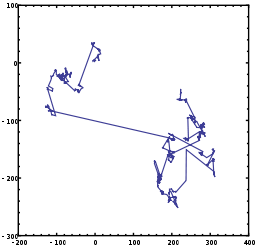
Lévy flight (from Wikipedia)
Humphries, N. E. et al. (2010), Environmental context explains Lévy and Brownian movement patterns of marine predators, Nature, 465(7301), 1066-1069, doi:10.1038/nature09116.
環境和海洋掠食者Lévy與布朗運動間轉換的關係
摘要;
An optimal search theory, the so-called Lévy-flight foraging hypothesis, predicts that predators should adopt search strategies known as Lévy flights where prey is sparse and distributed unpredictably, but that Brownian movement is sufficiently efficient for locating abundant prey.
Empirical studies have generated controversy because the accuracy of statistical methods that have been used to identify Lévy behaviour has recently been questioned. Consequently, whether foragers exhibit Lévy flights in the wild remains unclear. Crucially, moreover, it has not been tested whether observed movement patterns across natural landscapes having different expected resource distributions conform to the theory’s central predictions.
Here we use maximum-likelihood methods to test for Lévy patterns in relation to environmental gradients in the largest animal movement data set assembled for this purpose. Strong support was found for Lévy search patterns across 14 species of open-ocean predatory fish (sharks, tuna, billfish and ocean sunfish), with some individuals switching between Lévy and Brownian movement as they traversed different habitat types. We tested the spatial occurrence of these two principal patterns and found Lévy behaviour to be associated with less productive waters (sparser prey) and Brownian movements to be associated with productive shelf or convergence-front habitats (abundant prey).
These results are consistent with the Lévy-flight foraging hypothesis, supporting the contention that organism search strategies naturally evolved in such a way that they exploit optimal Lévy patterns.
2010年4月25日 星期日
開張 (New Opening!)
這個網站是經由大師兄克拉克先生的建議而設立,讓實驗室同仁們可以藉此交流最近看了什麼有趣的paper或書,學習整理摘要後分享給大家,然後討論。歡迎大家共襄盛舉!
ps. 如果各位同仁沒有google帳戶,請寄Email給ecoinforlab@gmail.com跟我要這個帳戶的密碼吧:)
----
hello everyone,
This website is for sharing interesting papers and books you recently read. Please enjoy it!
ps. If you don't have google account to post, please mail to ecoinforlab@gmail.com to get the password of this lab-public account.
ps. 如果各位同仁沒有google帳戶,請寄Email給ecoinforlab@gmail.com跟我要這個帳戶的密碼吧:)
----
hello everyone,
This website is for sharing interesting papers and books you recently read. Please enjoy it!
ps. If you don't have google account to post, please mail to ecoinforlab@gmail.com to get the password of this lab-public account.
訂閱:
意見 (Atom)

 發表文章
發表文章

